33 fotos


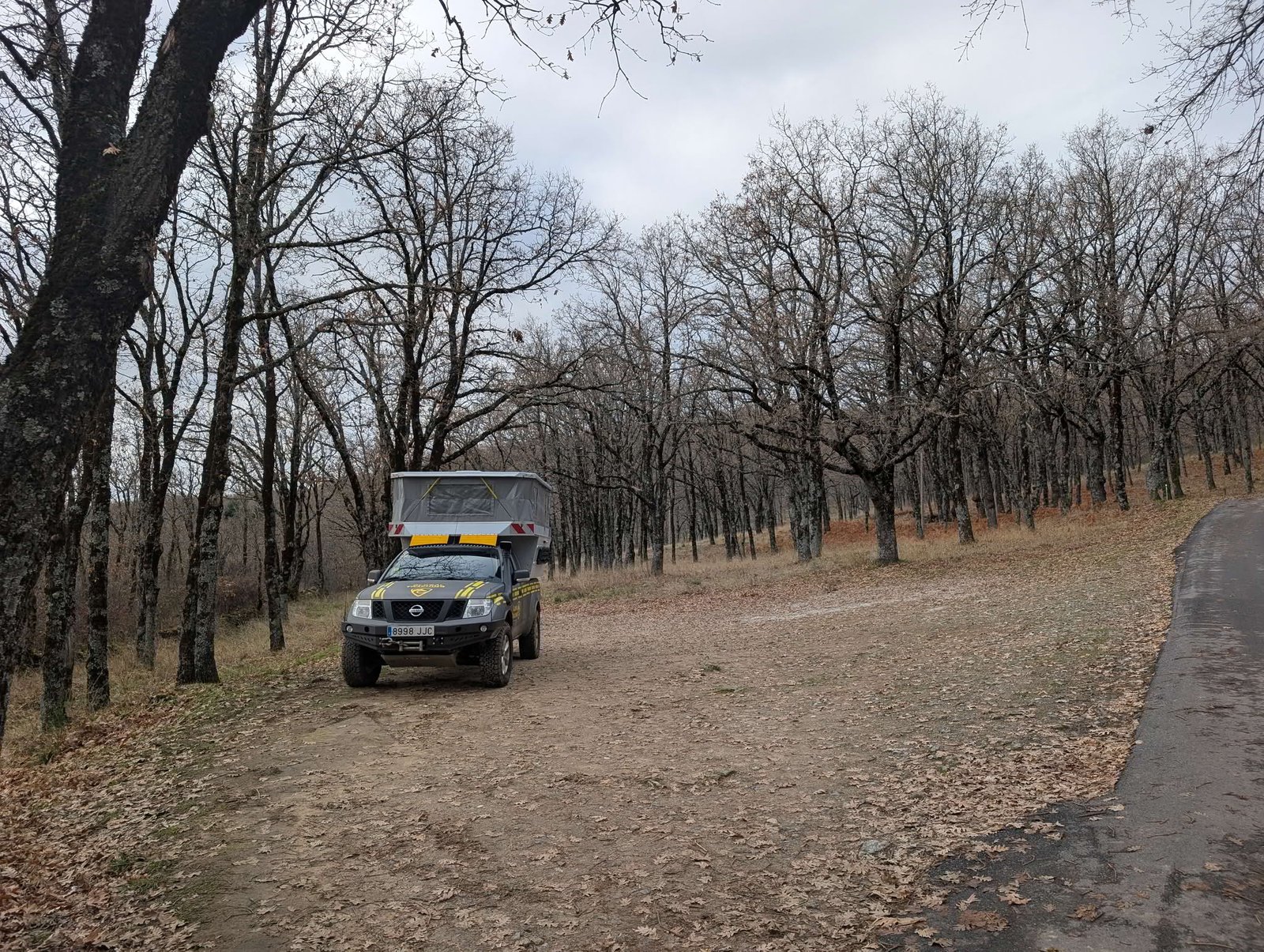
We woke up to pretty decent weather in that enormous dirt car park where we'd slept. No other cars, no lost humans, the whole place to ourselves. That gives me a feeling of conquered territory, although I don't actually mark anything because I'm polite. To start the day, we took a leisurely walk through the forest and, above all, went to see the Roman bridge of Talamanca de Jarama. This bridge isn't completely Roman, as I've informed myself by sniffing panels and listening to Edu. The origin is Roman, yes, but what you see today is more medieval, built between the 14th and 15th centuries on a previous structure. It has five enormous arches, is made of serious stone and for centuries was a key crossing point over the Jarama River for merchants, travellers and surely the odd dog in a hurry. Now it's there, quiet, imposing, as if saying "I've seen things pass, you're just strolling."
Between a little stroll, photos and my technical stops, it got late without us realising. At two o'clock we got in the car and headed north, destination Buitrago de Lozoya. Roughly an hour's drive, partly on the motorway, partly looking at mountains that were already hinting at interesting things. We parked on the outskirts and went straight to explore the old part of the village, which is a compact marvel well surrounded by water. Buitrago is literally embraced by the Lozoya River, as if someone had said "this village here and don't you move."
The first thing we saw was the Puente del Arrabal, also called the old bridge, and old is an understatement. It's medieval, from the 14th century, made of natural stone and a sturdy appearance, like a sheepdog that doesn't smile but looks after the flock. It was the main entrance to the village and still impresses to cross it today. From there we passed through the Arco del Piloncillo, one of the historic access gates to the walled enclosure. It's small, discreet and easy to miss, but it has that charm of a gate that has seen lives come and go for centuries.
We entered the old town and walked on the wall, which is one of the best preserved in the Community of Madrid. From above you can see everything round, the river surrounding the village, the houses packed inside and the open landscape around. It's like looking at a model but in real life. We arrived at the castle square, spacious, quiet and with an air of having been important in its day without needing to boast now. Then we crossed a door in the wall, quite hidden, to see the church of Santa María del Castillo. From the outside it's already beautiful, with its mix of Gothic and Mudejar styles, but Edu went inside and came out with a "it's worth it" look on his face. High ceilings, stone, calm and that silence that doesn't weigh you down.
After giving the village a good once over, we went back to the car and headed to Pinilla del Valle. There's a motorhome area near the Pinilla reservoir, but as soon as we saw it, we knew it wasn't our place. Functional, yes. Pretty, no. And I like to sleep with charm, not with the face of a supermarket car park. So we carried on a bit further, now heading south. We passed Rascafría, which we mentally noted for another day with more time, and continued up to the Puerto de la Morcuera.
The port is at 1796 metres and you can tell. Everything was covered by a good layer of snow and the cold bit, but the kind that wakes you up. There we stayed for a long while watching the spectacle of the children sliding down the slopes on sleds at full speed. Screams, laughter, gentle falls and parents pretending not to be nervous. I observed with professional attention, evaluating trajectories and thinking that, if I had thumbs, I might be encouraged. The views from above are amazing, open mountain, snow, clear light and a real winter feeling.
After sunset we continued in the car for about half an hour to Miraflores de la Sierra. There we found a perfect place to sleep, near the Fuente del Cura. A small car park, dirt, surrounded by forest, simple and very quiet. No indiscreet streetlights, no strange noises, just trees and good darkness. We parked, got settled in and here we stayed to sleep, with the feeling of having had a perfect day, the kind that mixes history, mountains and that rich tiredness that lets you sleep soundly.
Añadir nuevo comentario